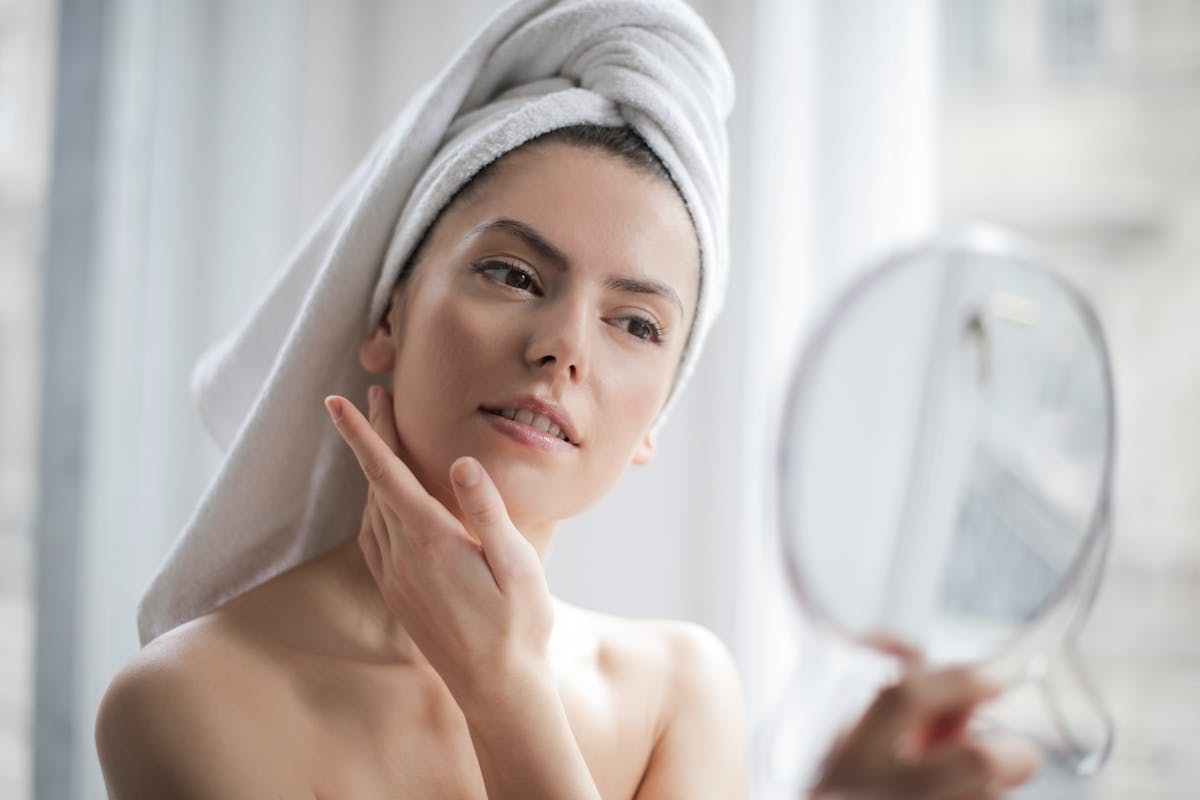
Perimenopause Skin Changes: What's Happening and What to Do First
if your skin suddenly feels drier, thinner, duller, or slower to recover, perimenopause may be part of the picture. here’s what may be changing biologically and what to do first.
Editorial note
LAKEHAUS Health articles are written for education and clarity. We aim to separate useful evidence from wellness theater, and we update articles when better information becomes available. This content is not medical advice and is not a substitute for care from a qualified clinician.
Perimenopause Skin Changes: What’s Happening and What to Do First
If your skin suddenly feels drier, thinner, duller, or less resilient, it may not be random.
Most women notice it before they have language for it.
Skin that used to feel relatively stable starts behaving differently — drier in ways moisturizer doesn’t fully resolve, thinner-looking in places it did not used to be, slower to recover from a breakout or a bad week of sleep. Lines that once appeared only with expression are now there at rest.
For some women, this happens gradually enough that it gets absorbed into a general sense of getting older. For others, it happens quickly, and the speed of it is what makes it feel off.
What often gets missed is the pattern underneath. These changes frequently cluster together, tend to track with other shifts happening in the body, and usually have a more specific explanation than “aging.” That explanation often starts with hormones.
This article is not about finding the right serum. It is about understanding what may be driving the change so you can respond more clearly.
Start the 6-Marker Skin Audit — a free tool to help you identify which changes are most active for you right now.
What May Be Happening Biologically
Perimenopause is the transition phase leading up to menopause. It often begins in the early-to-mid forties, though sometimes earlier and sometimes later. During this period, estrogen levels do not simply decline; they fluctuate. They can rise and fall within the same cycle. That unpredictability affects the entire body, and the skin is no exception.
| Biological Driver | Impact on Skin |
|---|---|
| Estrogen Fluctuation | Erratically affects processes maintaining hydration, plumpness, and resilience. Skin may feel normal one day and depleted the next. |
| Collagen Decline | Reduces the structural protein required for firmness, thickness, and resistance to lines. Effects compound quietly over time. |
| Hydration & Barrier Shifts | Decreases estrogen-supported lipid production, compromising moisture retention. Often feels tight or sensitive without an obvious cause. |
| Recovery & Wound-Healing | Slows cell turnover and alters inflammatory response. Irritation, blemishes, and pigmentation linger longer than they previously did. |
What Perimenopause Skin Changes Often Look Like
Every woman’s experience is different, but certain patterns appear often enough to be worth naming.
| Presentation | Common Characteristics |
|---|---|
| Unfamiliar Dryness | Persistent tightness or roughness (jaw, cheeks, eyes) that does not respond immediately to standard lotion. |
| Crepey or Thinner Texture | Fragile, less padded appearance, typically emerging first around the eyes, neck, or décolletage. |
| Reduced Elasticity | Slower "snap back" response; skin feels less taut and areas that once held their shape look subtly different. |
| Dullness or Uneven Tone | Flatter, grayer quality with less natural luminosity; hyperpigmentation may become pronounced. |
| Lines at Rest | Fine lines and creases (around the mouth, between brows, forehead) remain visible when the face is neutral. |
It is worth noting when these changes began and whether they appeared alongside other shifts — in sleep quality, energy, mood, or cycle regularity. That context matters.
Start the 6-Marker Skin Audit — a structured way to document what you are seeing and map it to the markers most commonly associated with hormonal skin change.
Why This Gets Misread
Several things interfere with women getting an accurate explanation for what is happening to their skin.
- It gets attributed to age in the abstract. “You’re just getting older” forecloses a more precise conversation. It involves specific biological mechanisms with specific implications. Conflating the two leaves women without actionable information.
- It gets treated as purely cosmetic. Because skin changes are visible, they often get routed straight into the beauty aisle rather than a health and hormones conversation. But skin is one of the first visible signals of a broader transition.
- It gets buried under skincare marketing. The industry meets anxious women at the exact moment they notice a change. Products may or may not be appropriate, and the marketing almost never explains the underlying biology.
That leaves many women carrying a vague but unresolved sense that something has shifted — without ever receiving an explanation that actually matches the experience. This article is an attempt to provide that explanation.
What to Do First
If your skin has changed and you are not sure what to do, resist the urge to add more products immediately. A better starting sequence:
Look for a pattern, not a single symptom
One change in isolation is less informative than multiple changes appearing at the same time. Dryness plus thinning plus slower healing plus disrupted sleep is a different kind of signal.
Put your skin in context
What else has shifted recently? Sleep quality, cycle regularity, energy levels, temperature regulation. If skin changes are appearing alongside other perimenopausal signals, that context matters.
Simplify before you add
If you are currently using multiple actives or switching products frequently, pause. A simpler routine with fewer variables makes it easier to understand what your skin is actually doing.
Document what you are seeing
Dates matter. Note when changes started, whether they have progressed, and what else was happening in your body at the same time.
Start the 6-Marker Skin Audit — the audit is designed to help you identify which changes are most significant for you and where to focus first.
When to Escalate
Most perimenopausal skin changes are gradual and fall within the range of what this transition can bring. Consider speaking with a clinician if:
- Skin changes appeared very abruptly, over days or weeks rather than months.
- You are experiencing significant thinning, fragility, or slow wound healing that feels disproportionate.
- Changes are paired with other systemic symptoms (significant fatigue, pronounced mood changes, hair loss, or unusual weight shifts).
- You have a personal or family history of autoimmune conditions, thyroid disorders, or other conditions that can affect skin.
This is not a complete list. If something feels medically wrong rather than transitional, trust that instinct and get it evaluated.
Closing
Your skin is not simply aging in some generic, inevitable way. It may be responding to a specific biological transition — one that affects collagen production, hydration, barrier function, and cellular repair in measurable ways.
That reframe matters. It shifts the question from “how do I fight this?” to “what is my body telling me?” and opens the door to responses that are more targeted and more honest.
The first step is not a new product. It is a better interpretation.
Frequently Asked Questions
Can perimenopause affect skin before menopause?
Yes. Perimenopause begins well before the final menstrual period — often by several years. Because skin has estrogen receptors throughout, it can respond to hormonal fluctuations before cycles have stopped or become obviously irregular. For some women, skin changes are among the earliest visible signs.
Why does my skin suddenly feel thinner or drier?
A likely explanation is changing estrogen levels. Estrogen supports both collagen production and the barrier function of the skin’s outer layer. When estrogen starts to fluctuate and decline, both thickness and hydration capacity can be affected.
Is collagen loss part of perimenopause?
It appears to be. Research has associated declining estrogen with reduced collagen production in skin. The rate of loss may be steeper during the menopausal transition than in later years, which helps explain why some women experience the change as sudden.
Are these changes always hormonal?
Not always. Skin changes can also reflect sleep disruption, stress, nutrition, sun exposure, thyroid issues, and other factors. Perimenopause does not explain everything. But when skin changes cluster with other midlife shifts, hormones are worth considering as a primary driver.
What should I do first if my skin has changed quickly?
Start by documenting what you are seeing, when it began, and what else has shifted. Then simplify your routine rather than adding new products. If the changes are severe, abrupt, or paired with other significant symptoms, see a clinician. If they feel more transitional, the Skin Audit is a useful place to start.
At Lakehaus, we review the evidence before making a recommendation. Learn about how we work.
Related: The 6 Visible Markers of Hormonal Skin Change
Identify Your Baseline
Start the 6-Marker Skin Audit — a free, structured tool to document what you are seeing and map it to the markers most commonly associated with hormonal skin change.
Start the 6-Marker Skin Audit"The first step is not a new product. It is a better interpretation."
Younger, Longer
Evidence-based routines for women. Dive deeper into the biology of perimenopausal skin.
Read the free chapter